Here is
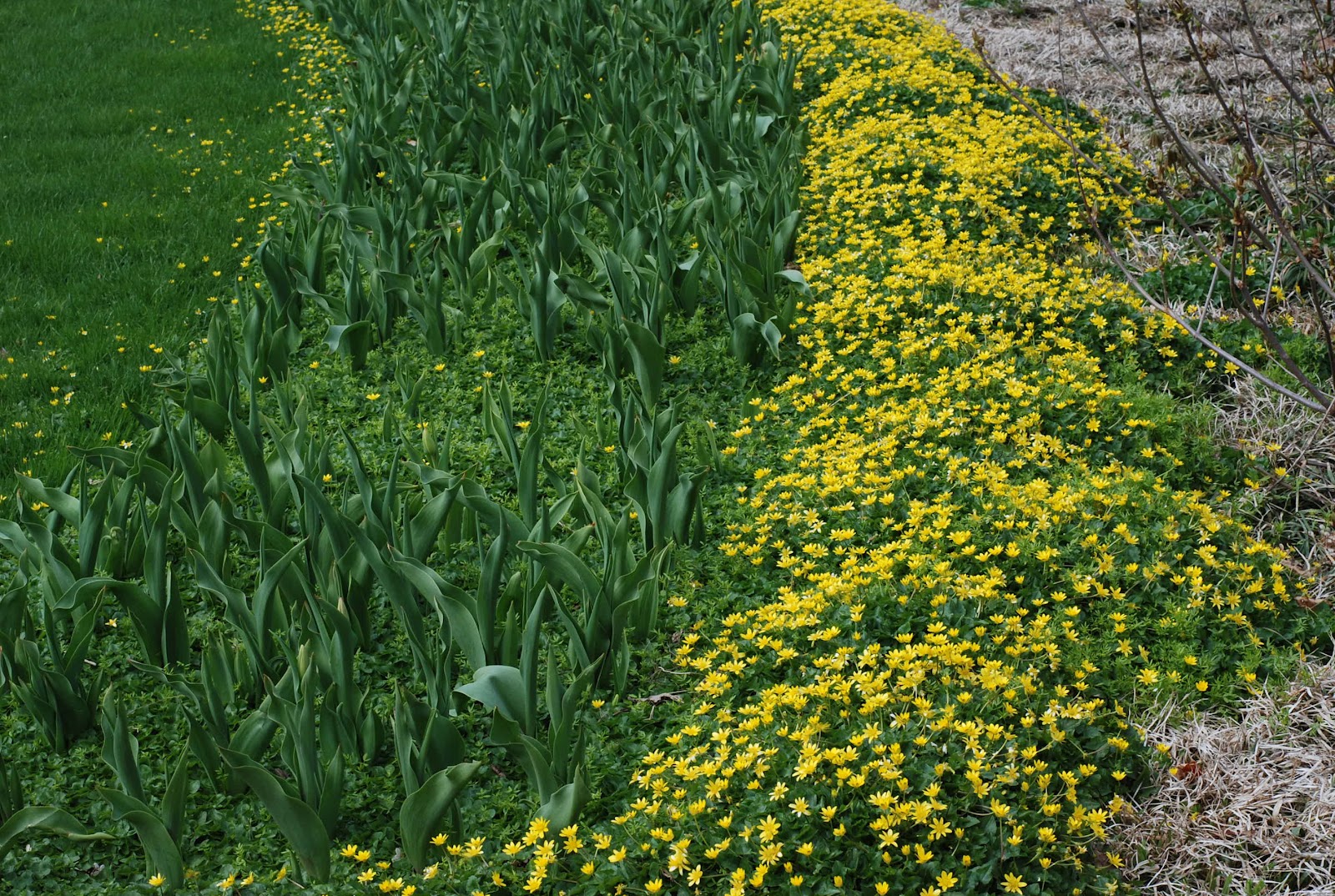
Ranunculus ficaria in a tulip bed. The plants amongst the tulips are slightly delayed in their flowering, but notice the vigor the plant has as it spreads into the perennial garden behind. Notice also how it is working its way into the turf on the other side.
Our crocus field is now followed by our
Ranunculus ficaria field where it drowns out anything that can't grow through its early spring dense canopy of leaves.
Liriope spicata is a strong dense groundcover, but
Ranunculus ficaria manages to find places to grow even here.
I was dismayed to read yet another gardener recommending
Ranunculus ficaria while dismissing its aggressively spreading habit as only a minor annoyance. I first encountered the beast many years ago in my mother's garden where she had planted the cute little thing into her shade garden only to be very frustrated several years later by its inexorable spread and persistent nature. "Inexorable" is the perfect word for its habit. The word's definition mentions synonyms of "unyielding" and "unalterable" which are two more words that fit the plant's habit. Perhaps people forget about how bad of a weed this is because of its short life cycle. It grows only in the spring.
Kingwood Center, where I work, is afflicted with the plant.
Ranunculus ficaria is the worst in the beds used for seasonal displays (see the image above). Apparently the rototillers pick up propagules and spread the plant from bed to bed. Now most of our seasonal display beds are full of the "pretty little groundcover". A couple of years ago we took the extreme measure of not installing the spring planting in some of the infested beds. As it emerged in the spring we repeatedly hit the
Ranunculus ficaria with herbicide. The next spring we noticed that all we had done was thin out the infestation. In two years it was as thick as ever. But wait, there's more!
This is not just a garden weed. I am not sure how it got into our woodland, but it made a successful invasion and is spreading
inexorably. But wait, there's more!
In the perennial gardens
Ranunculus ficaria insinuates itself into the crowns of perennials making its removal very difficult, and once ignored it fills all the spaces between larger plants and washes over any diminutive plants that might emerge weakly in the spring. But wait, there's more!
It is now in the lawn as well. I suppose a regular application of selective herbicide would control it in the lawn, but we try to avoid pesticides where we can, and we enjoy some of our flowering lawn "weeds" such as
Bellis perennis and
Veronica hederaefolia. And if one's retort would be why not accept it as yet another flowering lawn "weed" I would say that first it forms unattractive clumps and secondly it represents a source of inoculum for garden beds. But wait, there's more!
We feel good about our composting program that generates lots of useful organic matter for our gardens. Unfortunately
Ranunculus ficaria has found its way into that aspect of our operation as well, where it defies the heat of the composting action and the periodic turning of the piles. So now we are very wary of using our otherwise wonderful compost for fear of spreading the beast yet further. I added compost that I thought was
Ranunculus free last fall to help back fill some areas in the nursery and this spring I discovered three little colonies of
Ranunculus with more, no doubt, lurking elsewhere in the nursery.
Apologists for the plant say that the double forms are safe because they set no seed. Perhaps they are right, but I doubt it. The roots are full of tubers, which I suspect as one of their primary means of spreading as equipment and soil is moved from one bed to another.
It is against gardener's nature not to try every plant that intrigues them, so I expect this recommendation against
Ranunculus ficaria will fall on deaf years, but at least it was cathartic to write. The plant is a nightmare.