Thursday, July 12, 2012

The Search for and the Glory of the Blue Flower


Monkshood (this one is Aconitum carmicaelii 'Baker's Variety') is the object of romantic notions of the search for THE blue flower.

This gentian (Gentiana scabra) is so blue it looks fake, like an old time re-touched seed catalog. To my color challenged eyes this looks like a true blue, but if it is what does that make the above monkshood about whose blue flowers so much has been written?

There is something special about genuinely blue flowers. They are mythical, rare, revered, etc. We want a blue rose. Have you seen those preposterous dyed blue orchids at the grocery store? Plant mavens are mad for the special blue flowers of the blue poppy (Meconopsis) which frustratingly only grows in very cool climates. Everyone wants the blue flowers on their Hydrangea, not the pink. And so on and so forth. 

We know all that, more or less, right? But recently I was listening to a podcast by Radiolab, and they said something amazing about the color blue. "...across all cultures, words for colors appear in stages. And blue always comes last." They posited that if we are not taught the word blue (and its associated meaning) we wouldn't distinguish blue as an independent color! Incredible. Along this line of discussion they noted that the famous Greek poet, Homer, used many strange color references and never once used the word blue. Had the Greeks not developed the concept of blue by his time, or did it have something to do with Homer being blind? (By the way who counted all the color references in Homer's work?:  weirdly, the famous Victorian era British Prime Minister Gladstone.)

In another line of thinking about the color blue, and especially blue flowers I was listening to yet another podcast, this time about a German writer of the romantic period named Novalis. He wrote a novel called Heinrick von Ofterdingen in which the protagonist goes on a search for THE true blue flower. As it turns out that plant is Aconitum (Monkshood or in German Eisenhut). In trying to understand what this is all about I read that the search for this elusive blue flower is symbolic of human understanding of nature and self growth and enlightenment. (That probably comes straight from Wikipedia.) This also ties in with the long tradition of German nature hikes (Wandervogel) and their associated songs and societies.

So what, you say. Well, I guess blue flowers are something special, so why not glory in them along with Heinrick von Ofterdingen. So here are two. See above.

Wednesday, May 30, 2012

More Than a Moment


This picture was taken on 17 May. New things have come into flower in this garden since my 5 May posting and a few have hung on.

Several days later on 22 May no picture would be complete without including the foxgloves.


It is difficult to create a garden that is showy all season long. So often there is one big explosion of flowers followed by nothing much. I am pleased so far this year that one of my rock gardens has been exciting throughout the month of May, at least. My last posting in early May included a picture of the garden that I was proud of. This posting includes subsequent pictures in May of the same garden in about the same spot as the first. Of course, when the foxgloves and the cheddar pinks are finished the show will be dramatically muted, but I think it will still be of interest. Perhaps gratification will come from the little plants blooming in the cracks and crevices of the rockery.

Tuesday, May 8, 2012

Pride


It is a cliche to say a garden is always a work in progress, but it is also true. I am probably worst than most in seldom being satisfied with a current status of my gardens. I am always thinking and planning what's next. To me that is most of the fun, but every once in a while I need to sit back and say, "OK, that's pretty much what I was after". I did that the other day, so I grabbed my camera and recorded it. The photograph is above. An hour later I removed some weeds that I should have noticed before I took the picture, so obviously my satisfaction was fleeting, and since this picture was taken some dramatic additional flowers have come into bloom. So....

Monday, April 16, 2012

Revered Seedlings

 Veratrum nigrum
(black false hellebore)

 Cardiocrinum cordatum
(best known as being the "other" giant lily)

Glaucidium palmatum
(Japanese wood poppy)

Weeds tend to self-seed freely. That's usually why they are considered weeds, because they self-seed faster than the gardener can control them. Then there are those plants that give the gardener a pleasant surprise by self-seeding. Those are the ones I want to discuss today. In early spring as my perennials were still emerging I spent a few days trying to catch up on the weeding of a garden I am reorganizing. This weeding was not tedious but actually a bit of an adventure. With an interesting podcast in my ear to smooth out some of the repetitiveness of it all I had a good time seeing what was surviving and what was thriving under the new system, but the highlight was discovering that three of my favorite plants which had never self-seeded before had a few new progeny growing.

Gardens are all about balance. A garden is out of balance if the weeds are spreading faster than they can be controlled, or if cultivated plants die, fail to thrive, or grow so aggressively as to overwhelm neighboring plants and the gardener's ability to contain them. I like an informal, naturalistic garden in which everyone "gets along." Gentle spreading and occasional self sowing are signs of satisfied plants growing well in the environment provided. Their gentle self-sowing adds to the naturalistic affect while adding bulk makes for more flowers and opportunities for division. I recall my mother complaining about Fritillaria meleagris (guinea-hen flower). She said, "You plant one and you get one." What she meant was that it never increased in size or spread about. I wish she was still around, so I could share my pleasure in seeing mine multiply. (She was always my best garden confidant.)

Clearly we want a bit of reproduction among our plants, so discovering seedlings of these three (pictured) all in one day was a genuine source of pleasure.

Thursday, April 5, 2012

Ranunculus ficaria, the Demon Weed


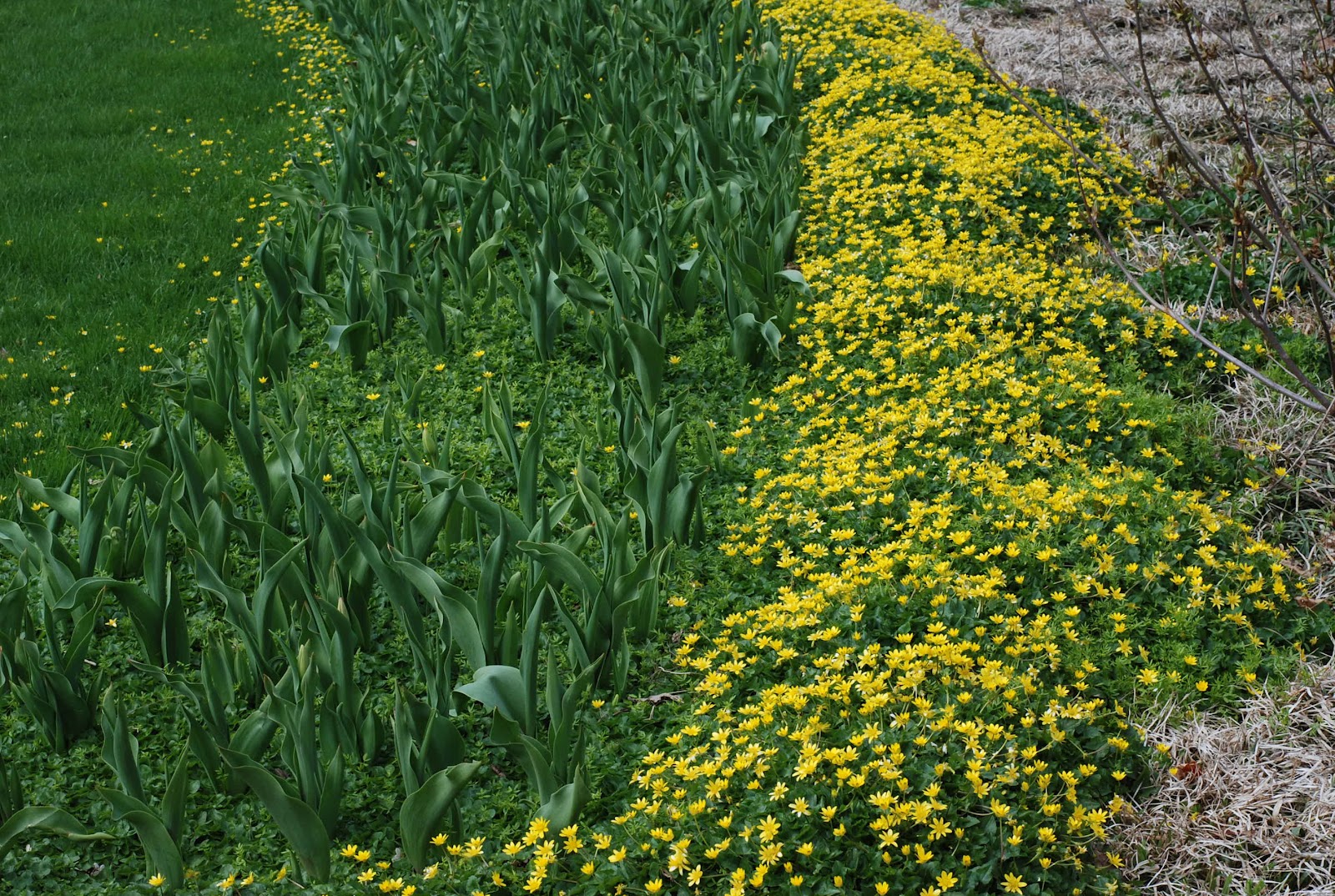
 Here is Ranunculus ficaria in a tulip bed. The plants amongst the tulips are slightly delayed in their flowering, but notice the vigor the plant has as it spreads into the perennial garden behind. Notice also how it is working its way into the turf on the other side.

 Our crocus field is now followed by our Ranunculus ficaria field where it drowns out anything that can't grow through its early spring dense canopy of leaves.


Liriope spicata is a strong dense groundcover, but Ranunculus ficaria manages to find places to grow even here.


I was dismayed to read yet another gardener recommending Ranunculus ficaria while dismissing its aggressively spreading habit as only a minor annoyance. I first encountered the beast many years ago in my mother's garden where she had planted the cute little thing into her shade garden only to be very frustrated several years later by its inexorable spread and persistent nature. "Inexorable" is the perfect word for its habit. The word's definition mentions synonyms of "unyielding" and "unalterable" which are two more words that fit the plant's habit. Perhaps people forget about how bad of a weed this is because of its short life cycle. It grows only in the spring.

Kingwood Center, where I work, is afflicted with the plant. Ranunculus ficaria is the worst in the beds used for seasonal displays (see the image above). Apparently the rototillers pick up propagules and spread the plant from bed to bed. Now most of our seasonal display beds are full of the "pretty little groundcover". A couple of years ago we took the extreme measure of not installing the spring planting in some of the infested beds. As it emerged in the spring we repeatedly hit the Ranunculus ficaria with herbicide. The next spring we noticed that all we had done was thin out the infestation. In two years it was as thick as ever. But wait, there's more!

This is not just a garden weed. I am not sure how it got into our woodland, but it made a successful invasion and is spreading inexorably. But wait, there's more!

In the perennial gardens Ranunculus ficaria insinuates itself into the crowns of perennials making its removal very difficult, and once ignored it fills all the spaces between larger plants and washes over any diminutive plants that might emerge weakly in the spring. But wait, there's more!

It is now in the lawn as well. I suppose a regular application of selective herbicide would control it in the lawn, but we try to avoid pesticides where we can, and we enjoy some of our flowering lawn "weeds" such as Bellis perennis and Veronica hederaefolia. And if one's retort would be why not accept it as yet another flowering lawn "weed" I would say that first it forms unattractive clumps and secondly it represents a source of inoculum for garden beds. But wait, there's more!

We feel good about our composting program that generates lots of useful organic matter for our gardens. Unfortunately Ranunculus ficaria has found its way into that aspect of our operation as well, where it defies the heat of the composting action and the periodic turning of the piles. So now we are very wary of using our otherwise wonderful compost for fear of spreading the beast yet further. I added compost that I thought was Ranunculus free last fall to help back fill some areas in the nursery and this spring I discovered three little colonies of Ranunculus with more, no doubt, lurking elsewhere in the nursery.

Apologists for the plant say that the double forms are safe because they set no seed. Perhaps they are right, but I doubt it. The roots are full of tubers, which I suspect as one of their primary means of spreading as equipment and soil is moved from one bed to another.

It is against gardener's nature not to try every plant that intrigues them, so I expect this recommendation against Ranunculus ficaria will fall on deaf years, but at least it was cathartic to write. The plant is a nightmare.

Friday, March 23, 2012

Diminutive Spring Flowers


A selection of English Daisy (Bellis perennis 'Rominette Red') with vivid red flowers


Asian twinleaf (Jeffersonia dubia) in a superior flower form from the specimen pictured below

This is my newest addition of Asian twinleaf and its sort-of blowzy flowers are far inferior to those I purchased several years ago, one of which is pictured above.


This tiny fritillaria (Fritillaria armena) is so diminutive and ephemeral I am amazed each season to see it return.


As spring is bursting upon us I am excitedly snapping pictures of the plants (new and old) that, for whatever reason, seem to stir me. The first is a selection of the often maligned and often weedy English daisy called Bellis perennis 'Rominette Red'. I bought this at Mulberry Creek Herb Farm in Huron, Ohio where one of their specialties is miniature plants. This brilliant red English daisy works wonderfully with my rock garden, but I could see lots of applications for it. It also has some sentimental value in that one of my mother's favorite illustrated books includes this plant with fairies or some other such creatures dancing beneath its flowers.

I bought an additional Asian twinleaf (Jeffersonia dubia) two years ago to supplements the plants I already have. Interestingly the new plant is not nearly as attractive in flower as the old ones. I don't doubt they are taxonomically the same, but there is an obvious horticultural difference. My older ones are, to me, an aesthetic marvel while the new one looks like a lavender form of our native twinleaf.

Another very diminutive plant that made a return engagement is my Fritillaria armena. Between being so tiny and going dormant a few weeks after blooming I was surprised to see it return after what was its third winter with me.

These are not tiny enough, perhaps, to qualify for what in school we used to call "belly plants" (because you have to get on your belly to see them), but they are definitely plants that need to be sought out to be noticed. I like a garden that has multiple levels of appeal depending upon the degree of scrutiny, especially when it rewards very careful and detailed observation.


Wednesday, February 22, 2012

Food, Learning How Much to Grow

Today I am venting about my ongoing difficulties with growing appropriate amounts of fruits, vegetables and nuts.  When I bought my property it already had a little orchard which I maintain by pruning. I don't spray, so my apples are less than perfect but very abundant; the cherry trees are either dead or the fruit is eaten by the birds; but the pears are usually unblemished and abundant. I get far more apples and pears than I could ever eat or preserve. I don't enjoy spending a lot of time preserving fruit, and no one else in my family is even as interested as I am, so in the fall the ground is covered with apples and pears.

As can be seen in the accompanying photograph I grew winter squash last year and two seed packets produced a wagon load. I have probably eaten ten or fifteen, but I harvested hundreds that are probably destined for the compost pile. Summer squash, green beans, and carrots are the same story. I keep up with asparagus for about three weeks before I have to give up and let it grow. I used perhaps a tenth of the hazelnuts I harvested. I hate the waste, but I just love growing things.

I have had some success with proportioning things. I seem to have just the right amount of blueberries, raspberries, concord grapes, and tomatoes. I dry the tomatoes, I begrudgingly share the blueberries with the birds who leave me enough for my cereal in the morning and the raspberries and grapes are like candy for me to pick four or five times a week for a few weeks. The potatoes store for a long time, so I get good use out of them as well. I have tried to grow produce such as lettuce with members of the household in mind, but their wants never seem to synchronize with harvest time, so I have largely given up on that.

I need to learn how to avoid over planting and how to select vegetables that are going to be broadly desirable. I don't have to put much work into my orchard, so as much as I hate to see the fruit not used I guess it really doesn't hurt anything. My fruiting shrubs (and vines) are doing well, but I continue to experiment with additional fruits that will complement what I already have. For example, I have seedless grapes, sweet-fruited blue honeysuckles, and ground-cover raspberries growing but not yet fruiting. Just for my amusement I also have paw paws, and persimons. One cooking experiment with each was enough to decide not to bother harvesting them any more.

The gardening lifestyle I am creating for myself calls for a wide range of appropriate quantities of food to enjoy in a relaxed manner throughout the growing season. I am still learning.

Thursday, January 26, 2012

The Long Wait

Corydalis 'Blackberry Wine' has disappeared from my garden in the past, so I was pleasantly surprised last spring to find this surviving bit of a larger clump from the year before.  

It is particularly problematic to have to wait to see if something has successfully seeded itself into your garden. All too often plants that self seed become pests. The nursery said this Papaver miyabeanum is short lived but would seed itself around. This planting represents my second try. We will see in the spring. 

Primula polyneura is one of the primroses I am hoping to convince to take up residence in my garden. This one looks a bit chlorotic and not very vigorous, so I wonder if it is happy enough to come back next year. 


Winter is the time for planning next year's garden, but as I plan I am anxious about what I can expect to see in the spring that survived the winter. For example, over the last few years I have been experimenting with primroses, and I want to continue to try more, but what will the fate be of the ones I planted last spring or even the spring before that? Many seem so vulnerable to any interruption in their ideal growing conditions that I always fear they will give up on me. If they go dormant in the late summer, as several do, I wonder, will they be back?

At work (Kingwood Center) I planted a hundred or so bare root Dicentra spectabilis (Bleeding Heart). I finally got around to planting them long after I wanted to because it was such a wet spring. In the end I practically pushed the bare roots into the mud. Amazingly they grew, but will they be back again this year?

Perhaps the biggest mystery is with my rock garden. Many of the plants I try among the rocks are said to be intolerant of winter-wet. Short of putting a roof over them in the winter (which is apparently often done by some very serious rock gardeners), I can only hope I have selected a sufficiently well drained site for my winter-wet sensitive plants.

Typically in gardening there are annual windows of opportunity (sometimes semiannual), and if the window is missed a year is lost. I often tell myself in August that I am going to reorganize a particular garden in the spring. Spring comes and goes, and I gnash my teeth the next year looking at the same problems I meant to fix. This problem is exacerbated when it is not certain even what plants to expect to be extant. Do I order plants for areas that may already be fully planted?

Part of the answer is to be a bit reckless. Cautious gardening doesn't work well on many levels and waiting to be sure will lead to overly modest or no action.

So as I sit hear thinking and writing I am convincing myself to charge ahead. Order more primroses; buy more plants for the rock garden; expect the bleeding heart to thrive. Time is more valuable than the cost of a few redundant plants.